

Most conversations about enterprise AI blur three distinct things together. Leaders talk about "AI readiness" or "AI transformation" as if it's one challenge. It's not. It's three—and conflating them is one of the most expensive mistakes an organization can make.
We call them AI Literacy, AI Maturity, and AI Innovation. They're different capabilities, with different requirements, pursued for different reasons. Your strategy determines which matter—and in what order.
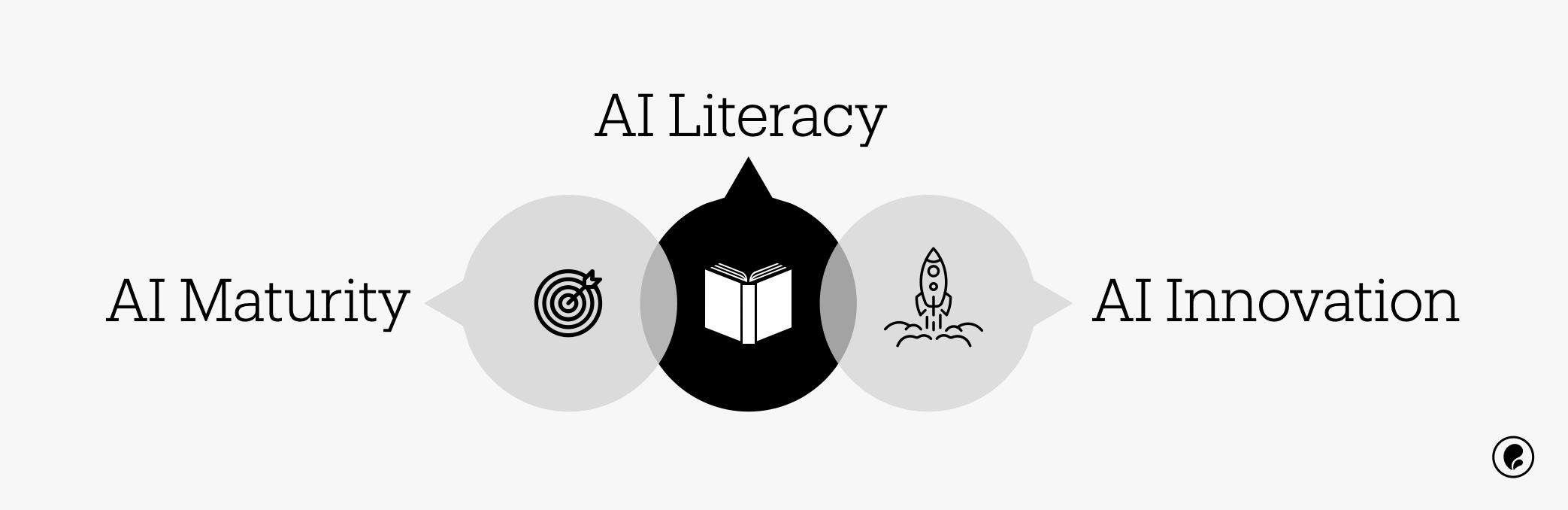
AI Literacy
Can your people use AI effectively?
This is the individual capability question. Not just prompting skills or tool familiarity—judgment. Can your people evaluate what AI can do? Do they understand what it can't? Do they know when to trust it and when to question it?
Literacy is foundational. Without it, every other AI investment is compromised. Leaders approve initiatives they don't understand. Teams adopt tools without knowing their limits. Organizations make commitments based on vendor demos and headlines.
The shape of AI literacy depends on your goal. If you're building toward AI Maturity, you need literacy broad and diffuse—spread across functions, levels, and roles. You can't have a mature organization with a handful of literate people. Maturity is essentially literacy scaled and supported by organizational infrastructure.
If you're building toward AI Innovation, you need literacy deep and concentrated—in the team building the AI-enabled offering. The whole organization doesn't need to understand AI deeply for a product team to ship something transformative. But that team needs to be exceptional.
This distinction matters for how you invest. Broad literacy programs look different from deep capability building. Most organizations default to one approach without asking which they actually need.
AI Maturity
Can your organization deploy AI at scale, responsibly?
This is the organizational capability question. Governance. Technology. Operations. Culture. Strategy. Skills. Risk ownership.
Maturity is what turns successful pilots into sustainable value. Without it, you get a familiar pattern: promising experiments that never scale, shadow AI spreading through the organization, governance that's either absent or so heavy it blocks everything.
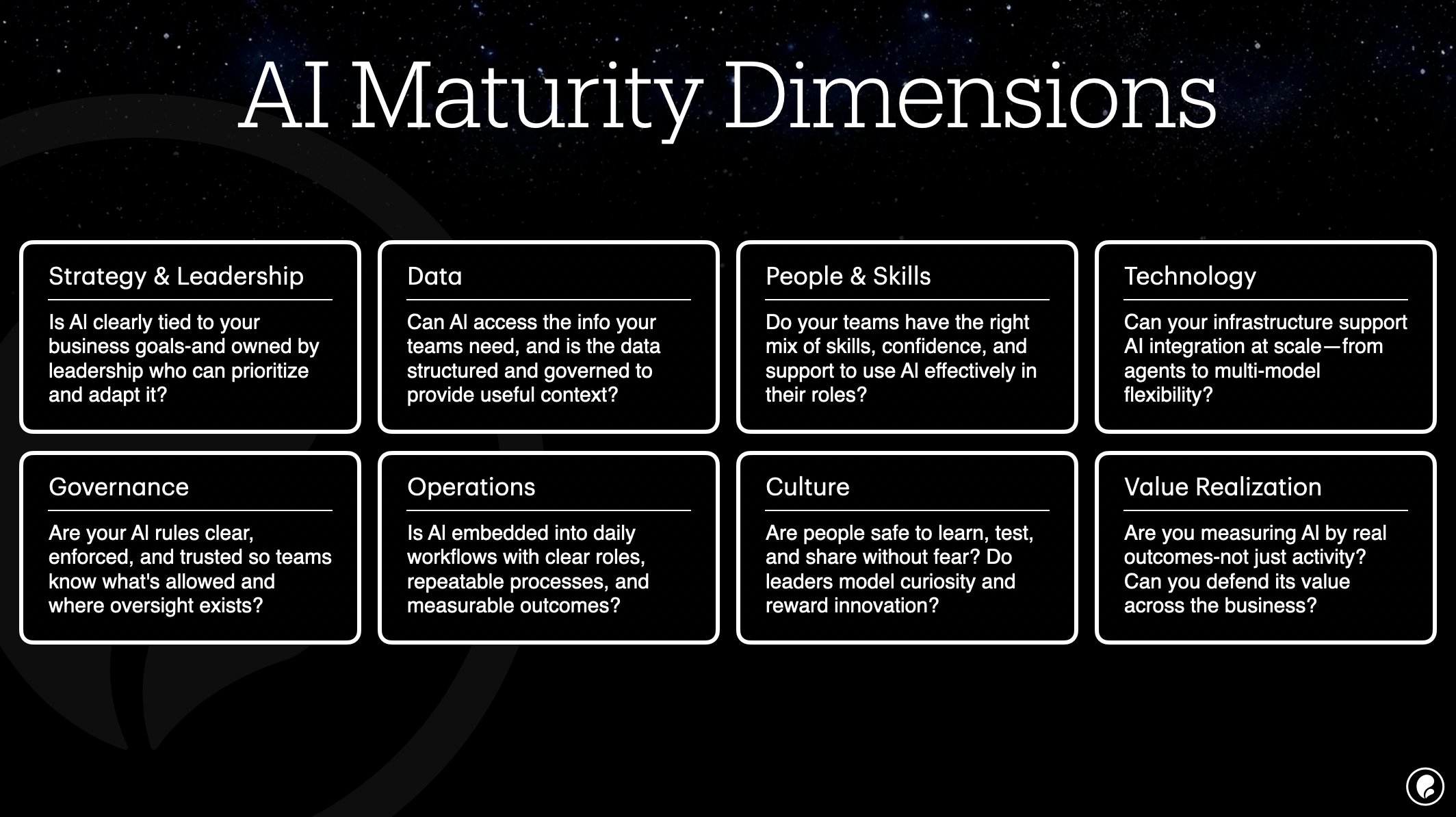
A mature organization consistently demonstrates the ability to:
- Deploy AI across functions, not just in isolated experiments
- Govern responsibly without creating gridlock
- Measure value, not just activity
- Absorb change into existing workflows
- Know who owns decisions and outcomes
Maturity requires broad literacy as a foundation. But it also requires infrastructure most organizations underestimate: clear policies, integrated data systems, defined accountability, and leadership that understands what they're approving.
Many organizations have high AI ambition and low AI maturity. They've run pilots. They've trained people on tools. They've appointed AI leads. But they haven't done the harder work of building the organizational muscle to deploy AI at scale.
AI Innovation
Is AI changing what you offer to the market?
This is the business model question. Not using AI to improve internal operations—rethinking what you sell, how you create value, or who you compete with.
This is where the conversation gets uncomfortable.
Not every organization needs to prioritize AI Innovation. A regional utility doesn't need to rethink what electricity is. A manufacturing company might get more value from operational excellence than from reinventing their product line. The pressure to "transform" is often vendor-driven, not strategically sound.
But for some organizations, innovation is existential. You need to seriously consider AI Innovation when:
- Your core value proposition is knowledge work that AI can increasingly perform—legal research, financial analysis, content creation, code generation
- Your competitive advantage depends on processes AI can dramatically compress—drug discovery, materials science, design iteration
- Your industry is being unbundled by AI-native entrants—education, media, professional services
- Your customers' expectations are being reset by AI experiences elsewhere
For organizations in these positions, maturity is necessary but insufficient. The question becomes: what business are we actually in when the thing we used to sell becomes a feature?
AI Innovation doesn't require AI maturity. Many companies succeeding with AI products/services have strong innovation execution in a focused pocket—a team, a product surface, access to data, tolerance for uncertainty—while the rest of the organization remains operationally traditional. This is a legitimate strategy, not a contradiction.
Innovation requires deep, concentrated AI literacy in the team doing the building. It requires focused execution capacity. It doesn't require that your entire organization be AI-mature first.
These Are Not Stages
The biggest misconception is that AI Literacy leads to AI Maturity leads to AI Innovation—a neat progression you climb.
It's not a ladder. They're distinct capabilities that can be pursued independently.
An AI-native startup might have innovation baked into their business model while being operationally immature—chaotic internal processes, no governance framework, ad hoc tool usage. Meanwhile, a Fortune 500 insurer could achieve mature AI operations across the enterprise while still fundamentally selling the same policies through the same channels.
Neither is wrong. They're pursuing different capabilities because they have different strategic needs.
The discipline is choosing the right mix for your organization—not assuming you need all three, not pursuing them in a predetermined sequence, and not confusing one for another.
The Cost of Category Confusion
When organizations conflate these capabilities, they make predictable mistakes:
- Mistaking Literacy for Maturity. "We trained everyone on AI tools" doesn't mean you can deploy AI at scale. Training individuals while ignoring governance, infrastructure, and strategy produces demos and pilots, not transformation.
- Mistaking Maturity for Innovation. "We're using AI across the organization" doesn't mean you're prepared for how AI might reshape your industry. You can be operationally excellent with AI and still get disrupted by a competitor who reimagined the business model.
- Mistaking Innovation for Maturity. "We launched an AI product" doesn't mean you know how to govern AI responsibly at scale. Plenty of companies building AI solutions are a mess internally.
- Assuming Innovation is always necessary. The pressure to transform can lead organizations to pursue reinvention when they actually need operational discipline. Not every company needs to become AI-native.
The Strategic Question
What is the primary AI capability that your strategy requires?
For some organizations, the answer is AI literacy—building the foundation of understanding across the leadership team. For others, it's AI maturity—turning experiments into scalable, governed capability. And for others, it's AI innovation—rethinking what they offer entirely.
Most organizations need to focus on one or two of these, not all three. The strategic discipline is knowing which ones, in what order, and how much.
That's where clarity comes from and where focus follows.
This framework guides how we work with organizations at Maginative. If you're trying to determine which capability matters most for your organization, let's talk.