
Most companies are asking the wrong AI question. They are asking: how do we add AI to the business? That sounds practical, but it's a trap.
The modern company was designed around human scarcity. Work was divided into functions because people had limited context. Layers of management existed because information moved slowly. Meetings existed because coordination was expensive. Software systems became systems of record because humans needed a shared place to store, retrieve, and approve work.
AI does not simply make that system faster. It changes the premise.
If one person can now prototype a product, generate customer research, write code, test workflows, produce creative variations, and coordinate agents across multiple tasks, then the basic unit of work is no longer the task. It is the workflow. And the basic unit of organization is no longer the department. It is the high-context pod — a small cross-functional team that owns a workflow end-to-end.
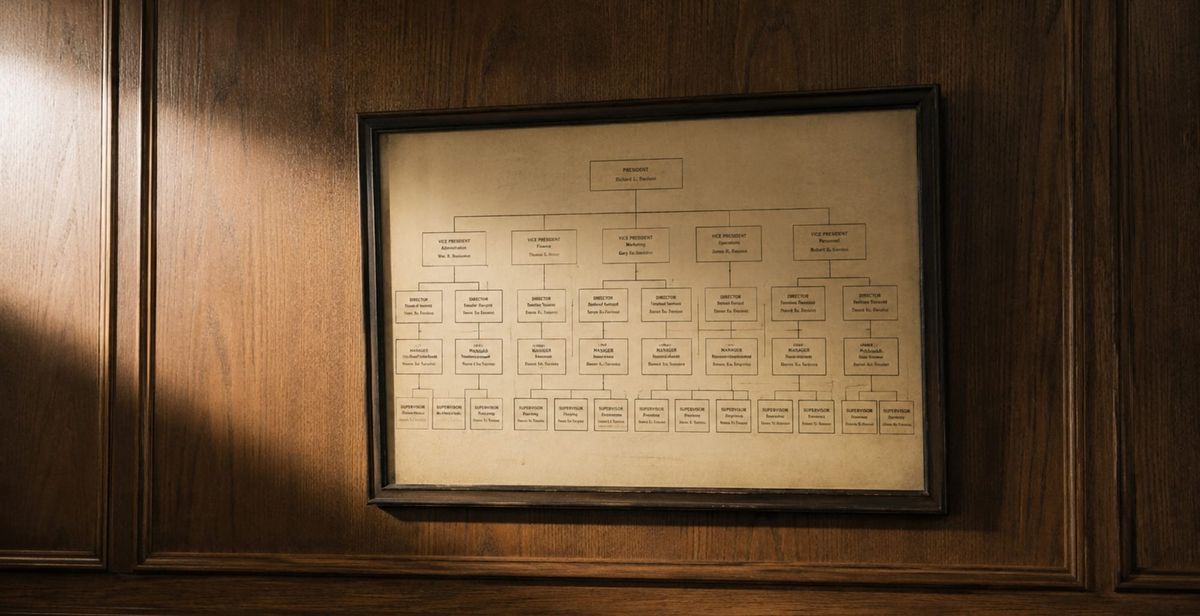
That is why so much "AI transformation" will disappoint. It assumes the company stays basically the same. The org chart remains. The process remains. The approval chain remains. The quarterly planning ritual remains. Then AI is inserted into each box as a productivity layer.
The big consulting firms have spent the last two years selling frameworks, maturity models, governance taxonomies, and centers of excellence — the entire apparatus of digital transformation, repackaged. Their own reports increasingly admit that the engagements aren't producing value. The proposed fix is always a larger engagement.
I'll be honest about my own position. Maginative built AIMark, an eight-dimension maturity assessment model used by Fortune 500 leadership teams. So this critique cuts close. But any maturity framework built before the agentic shift — including ours — was implicitly measuring progress toward a more AI-enabled version of the company that already exists. That destination is no longer the right one. A useful framework today has to surface the structural question, not paper over it: are you trying to become a better version of yourself, or are you the wrong shape for what's coming?
Last year, Tobi Lütke, CEO of Shopify, shared a memo that he sent to the entire company:
Before asking for more Headcount and resources, teams must demonstrate why they cannot get what they want done using AI. What would this area look like if autonomous AI agents were already part of the team?
Stagnation is almost certain, and stagnation is slow-motion failure.
Lütke was not announcing a tool rollout. He was changing the default operating assumption of the company: that the answer to a problem is more headcount. Once that default flips, almost everything downstream has to be rebuilt — performance reviews, hiring rubrics, planning cycles, team composition. Shopify made AI fluency a formal part of 360 reviews. Headcount has stayed roughly flat while revenue has continued to grow at 20–40% a year. That is the redesign. Adding Copilot licenses is not.
Earlier this month, Brian Armstrong, CEO of Coinbase, went further. His memo announcing the layoff of 14% of the company is the clearest statement yet of what an AI-native rebuild actually means in practice:
All of this has led us to an inflection point, not just for Coinbase, but for every company. The biggest risk now is not taking action. We are adjusting early and deliberately to rebuild Coinbase to be lean, fast, and AI-native. We need to return to the speed and focus of our startup founding, with AI at our core.
To get there, we are not just reducing head count and cutting costs, we're fundamentally changing how we operate: rebuilding Coinbase as an intelligence, with humans around the edge aligning it.
He then describes the actual structural changes:
No pure managers: Every leader at Coinbase must also be a strong and active individual contributor. Managers should be like player-coaches, getting their hands dirty alongside their teams.
AI-native pods: We'll be concentrating around AI-native talent who can manage fleets of agents to drive outsized impact. We'll also be experimenting with reduced pod sizes, including 'one person teams' with engineers, designers, and product managers all in one role.
This is not an "AI strategy"; it's an organizational thesis. Armstrong is arguing that the unit of work has changed, so the unit of organization has to change with it. The layer cap, the manager redefinition, the one-person pods — those are second-order consequences of taking the first claim seriously.
Of course, you also don't need to look very hard to find examples of CEOs who failed. Klarna went furthest, fastest, on the rhetorical front — froze hiring, claimed its AI chatbot was doing the work of 700 humans, talked about cutting its workforce in half. Then the CEO walked it back: "In a world of AI nothing will be as valuable as humans!" The lesson is not that AI-first is hype. It is that Klarna was solving the wrong problem. They treated AI as a way to simply replace people doing the existing work, rather than as a reason to redesign the work itself. The companies getting this right are asking what the work itself looks like when humans and agents are on the team together.
The important point is not layoffs. Some CEOs will absolutely use AI as a convenient story for cuts they wanted to make anyway. That will happen. But dismissing the whole pattern as cost-cutting misses the deeper shift.
The reality is that AI breaks the headcount logic of the firm.
For decades, growth meant adding people, then adding managers to coordinate those people, then adding systems to coordinate the managers. Complexity was the tax paid for scale. AI attacks that tax directly. It lets smaller groups absorb more context, execute more variants, and compress the distance between idea and shipped work.
The workforce is already starting to bend before the org chart does. Stanford's 2026 AI Index Report, published in April, found that employment for 22- to 25-year-old software developers has fallen nearly 20% from its 2024 level, even as employment for older developers in the same occupations has continued to grow. Across all AI-exposed occupations, the relative employment decline for 22- to 25-year-olds is roughly 16% after controlling for firm-level shocks. The pattern matters because the declines are concentrated where AI is more likely to automate work, not augment it. In other words, the first part of the company to compress is not the executive layer. It is the entry-level work that used to feed the org chart from the bottom.
That does not mean humans disappear. It means the valuable human work moves up the stack. The durable roles are not "person who completes task." They are person who frames the problem, sets the taste bar, understands the customer, designs the workflow, reviews the output, manages risk, and knows when the machine is wrong.
That is an entirely different company.
It needs fewer coordinators and more player-coaches. Fewer status meetings and more observable workflows. Fewer handoffs and more end-to-end ownership. Fewer people waiting for permission and more people trusted to command systems.
None of this is new. The last time a general-purpose technology rewrote the production function of work, the same divide opened. The names on the survivor list are not interesting because they were prescient — they are interesting because they were nearly dead. The New York Times almost went under twice in the 2000s before Sulzberger Jr. accepted that digital subscriptions were the business and print was the ghost. Microsoft was the most-hated company in tech in 2014 when Satya Nadella killed the Windows-first identity that had defined the company for thirty years. Best Buy was being shorted as the next Circuit City when Hubert Joly walked in and decided physical stores would compete with Amazon on what Amazon couldn't do. Survival required the CEO to put a knife into the part of the business that had built the company.
The other names are the ones the survivors avoided becoming. Sears had every advantage Amazon had — catalog DNA, distribution, brand, customer data — and ran transformation programs for two decades. Kodak invented the digital camera in 1975 and ran transformations into bankruptcy. Blockbuster passed on buying Netflix for $50 million and ran transformations to compete with it. Borders outsourced its online business to Amazon to focus on the core. Every one of these companies had a transformation strategy. Every one of them had decks. Their transformation did not save them.
Every executive reading this knows these names. They cite them in board meetings. They are running the same play anyway — adding AI to the side of the company, calling it a strategy, and protecting the existing structure while the technology underneath it changes the work. The companies that survive treat the technology as a reason to rebuild. The companies that don't treat it as a feature to add. There is no third option. AI is forcing the same choice, but faster.
Most companies will avoid it because the answer threatens too many existing structures. So they will run pilots, buy tools, form committees, publish roadmaps, and call it transformation.
They will mostly remain the same company, with a higher software bill.
The few that come out the other side will be the ones that built something different.